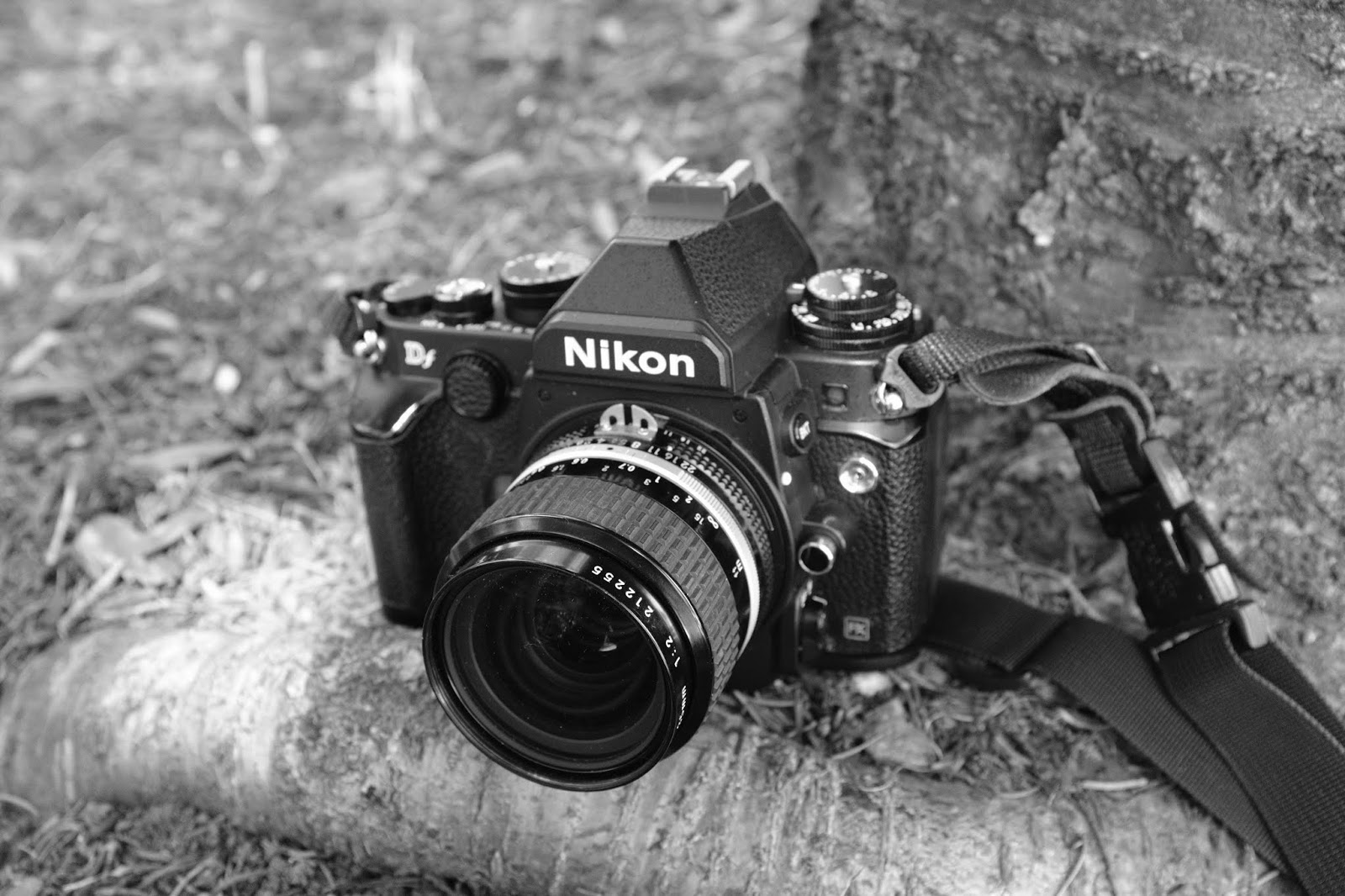
Pictured: Nikon Df in black with a Nikkor 35mm ais

Nikon Df next to my trusty F3, "Black Betty"
You can't really tell from this photo, but the Df is actually a bit taller than the F3
The Df was Nikon's most controversial offering when it was first introduced in 2013. People considered it a gimmick, a hipster camera. After five years, it is still being made, so there is obviously a market for it. What attracted me to the Df was the fact that it promised to be a digital camera that worked just like my F3. I could easily use my existing collection of Nikkor lenses with it. I bought it for my photography coursework. The traditional control layout, which makes perfect sense if you have any experience at all with old cameras, makes manual shooting intuitive. It feels like an instrument that you have used before.
The salesperson at the store suggested that I look for a used example, since they are still expensive new, and that if I decided that I didn't like it, I wouldn't have lost as much money. Well, after a few weeks with this Df, I have to say that I would have gladly purchased it new. The camera did not come from the ebay seller with the English version of the owner's manual, but I did not miss it. I figured out most of the camera on my own, it is THAT easy. After a few weeks of use the the rubber cover on the grip began separating. I ordered a new rubber piece directly from Nikon and it was very inexpensive. The grippy surfaces on all of my decades-old film cameras have not gone anywhere. Nikon, please get a better glue.
The salesperson at the store suggested that I look for a used example, since they are still expensive new, and that if I decided that I didn't like it, I wouldn't have lost as much money. Well, after a few weeks with this Df, I have to say that I would have gladly purchased it new. The camera did not come from the ebay seller with the English version of the owner's manual, but I did not miss it. I figured out most of the camera on my own, it is THAT easy. After a few weeks of use the the rubber cover on the grip began separating. I ordered a new rubber piece directly from Nikon and it was very inexpensive. The grippy surfaces on all of my decades-old film cameras have not gone anywhere. Nikon, please get a better glue.
It seems to me that the Df is much maligned by internet reviewers because it's just not the right tool for everyone and those for whom it's not the right tool think that it sucks because it dosn't fit THEM. It's the right camera for me and MIGHT be the right camera for you.
The made-in-Japan Df's mostly metal construction gives the confidence of a solidly built camera. It feels like it has Nikon's famed blunt instrument ruggedness. The one thing that confuses me is one part that ISN'T metal. The front plate where the lens mount attaches is some sort of plastic, which is weird. The rear screen is fixed. That's fine with me. articulating screens are another thing that can break. The 100% coverage viewfinder is huge, but it's too bad there isn't an eyeypiece curtain for long exposures.
The first things that you are going to notice are the pentaprism, which takes it's shape from the FM/FE series film cameras. The "Nikon" badge at the top uses Nikon's classic boxy lettering instead of the slanted lettering Nikon has been using since the late 1980s. It is Nikon's lightest full frame DSLR, even lighter than the D610. It feels close to the weight of an F3. The clearly numbered dials on the top give off a stempunk vibe. The hand grip is pretty small, it's not the big-bulbous battery grips of modern SLRs.
The grip brings up the first common criticism, the camera's ergonomics. Without the big grip, you are not going to be doing the one-handed running and gunning that you might be used to with other DSLRs. If that is the way you need to shoot, then the Df is not the camera for you.The Df wants to be held like a classic camera. Cradle it from underneath in your left hand and steady it with your right. The wheel on the front of the camera right below the shutter release is the command dial that changes the aperture. You can teach your finger to find it with some practice, but, if you use pre-G lenses you can shut off the command dial and use the aperture ring, which for me is a much more instinctive way to operate. Speaking of lenses, owners of classic Nikkor glass are in luck. You have the complete range of Nikkor F-mount lenses going back to 1959 to work with. The lens mount on the Df has an auto indexing tab for ai-ais lenses. The tab even folds away so you can use pre-ai lenses.
The Df has a single SD card slot. Dual slots would have been nice. There are times when you might want to record image files as .RAW on one card and .JPG on the other. Or, you might want to pass one card on to someone else and keep the other. There are many reasons that you might want your images stored in two physical locations, including piece of mind. I only had one SD card ever fail on me though, and that only happened after years of writing and eracing.
The Df does not do video. If you need a DSLR for video work, then the Df is not the camera for you obviously. I don't do video, so, I don't care. The Df has the same 16.2 MP full frame sensor as the D4. In a world of 30+ MP sensors, 16.2 suddenly seems mighty low, but it's enough to make a decent size print. The Df's sensor is said to have the best low light performance of anything that Nikon has. I don't have the experience to confirm this. The Df has the same 39 point autofocus system as the Nikon D600/D610, where the AF points are crowded into the middle of the frame. This is too pedestrian for some. It's fine with me. I'm used to cameras with one focus point. If you make your bread and butter shooting sports and action, Nikon offers tools other than the Df for that.
All the important controls are knobs and levers on top of the camera placed just where you would expect them if you used any 35mm film camera made since 1960. Shutter speed control is on the top shutter speed wheel, but can be changed to the thumb wheel allows you to make changes in 1/3 stops when that is needed. The ISO and exposure compensation dials are on the left side of the prism, right where they should be. If you like changing your ISO with one finger while keeping your eye glued on the viewfinder, the more traditional setup might seem like a downgrade for you, but is suits my shooting style just fine. Auto ISO exists, but you need to access it through the menus. It would have been better to put it directly on the knob for those of us who hate menus.
So, the Df is imperfect, but it's imperfections don't really subtract from the experience that Nikon is trying to offer the photographer with this camera. It's worth talking about the Df's actual raison d'etre. Among Nikon's full frame lineup, the Df is not trying to be a single-digit flagship model, nor is it trying to be anything like the 600, 700, or 800 series cameras. For $2,996.95 typical retail new, we are talking about professional camera prices here. This, and the premium sensor both point to the fact that this is to be seen as a serious machine, but it's filling it's own niche. The phrase "it's not a flaw, it's a feature" suits the Df well. There are a few throwback design cues, but the functionality of the camera is not about any nostalgia trip or ironic hipsterism. The old school top mounted and locking controls intentionally slow you down and create a more contemplative shooting style. The clicking, spinning dials, reasonable size and weight, solid feel, and huge viewfinder give a visual and tactile experience that encourages a relationship with the machine. The camera that you leave at home is not doing you any good. The Df begs to be taken out and used and begs to be used in full manual. It exists to put a certain kind of fun into producing photographic art.


The Df has a single SD card slot. Dual slots would have been nice. There are times when you might want to record image files as .RAW on one card and .JPG on the other. Or, you might want to pass one card on to someone else and keep the other. There are many reasons that you might want your images stored in two physical locations, including piece of mind. I only had one SD card ever fail on me though, and that only happened after years of writing and eracing.
The Df does not do video. If you need a DSLR for video work, then the Df is not the camera for you obviously. I don't do video, so, I don't care. The Df has the same 16.2 MP full frame sensor as the D4. In a world of 30+ MP sensors, 16.2 suddenly seems mighty low, but it's enough to make a decent size print. The Df's sensor is said to have the best low light performance of anything that Nikon has. I don't have the experience to confirm this. The Df has the same 39 point autofocus system as the Nikon D600/D610, where the AF points are crowded into the middle of the frame. This is too pedestrian for some. It's fine with me. I'm used to cameras with one focus point. If you make your bread and butter shooting sports and action, Nikon offers tools other than the Df for that.
All the important controls are knobs and levers on top of the camera placed just where you would expect them if you used any 35mm film camera made since 1960. Shutter speed control is on the top shutter speed wheel, but can be changed to the thumb wheel allows you to make changes in 1/3 stops when that is needed. The ISO and exposure compensation dials are on the left side of the prism, right where they should be. If you like changing your ISO with one finger while keeping your eye glued on the viewfinder, the more traditional setup might seem like a downgrade for you, but is suits my shooting style just fine. Auto ISO exists, but you need to access it through the menus. It would have been better to put it directly on the knob for those of us who hate menus.
So, the Df is imperfect, but it's imperfections don't really subtract from the experience that Nikon is trying to offer the photographer with this camera. It's worth talking about the Df's actual raison d'etre. Among Nikon's full frame lineup, the Df is not trying to be a single-digit flagship model, nor is it trying to be anything like the 600, 700, or 800 series cameras. For $2,996.95 typical retail new, we are talking about professional camera prices here. This, and the premium sensor both point to the fact that this is to be seen as a serious machine, but it's filling it's own niche. The phrase "it's not a flaw, it's a feature" suits the Df well. There are a few throwback design cues, but the functionality of the camera is not about any nostalgia trip or ironic hipsterism. The old school top mounted and locking controls intentionally slow you down and create a more contemplative shooting style. The clicking, spinning dials, reasonable size and weight, solid feel, and huge viewfinder give a visual and tactile experience that encourages a relationship with the machine. The camera that you leave at home is not doing you any good. The Df begs to be taken out and used and begs to be used in full manual. It exists to put a certain kind of fun into producing photographic art.